
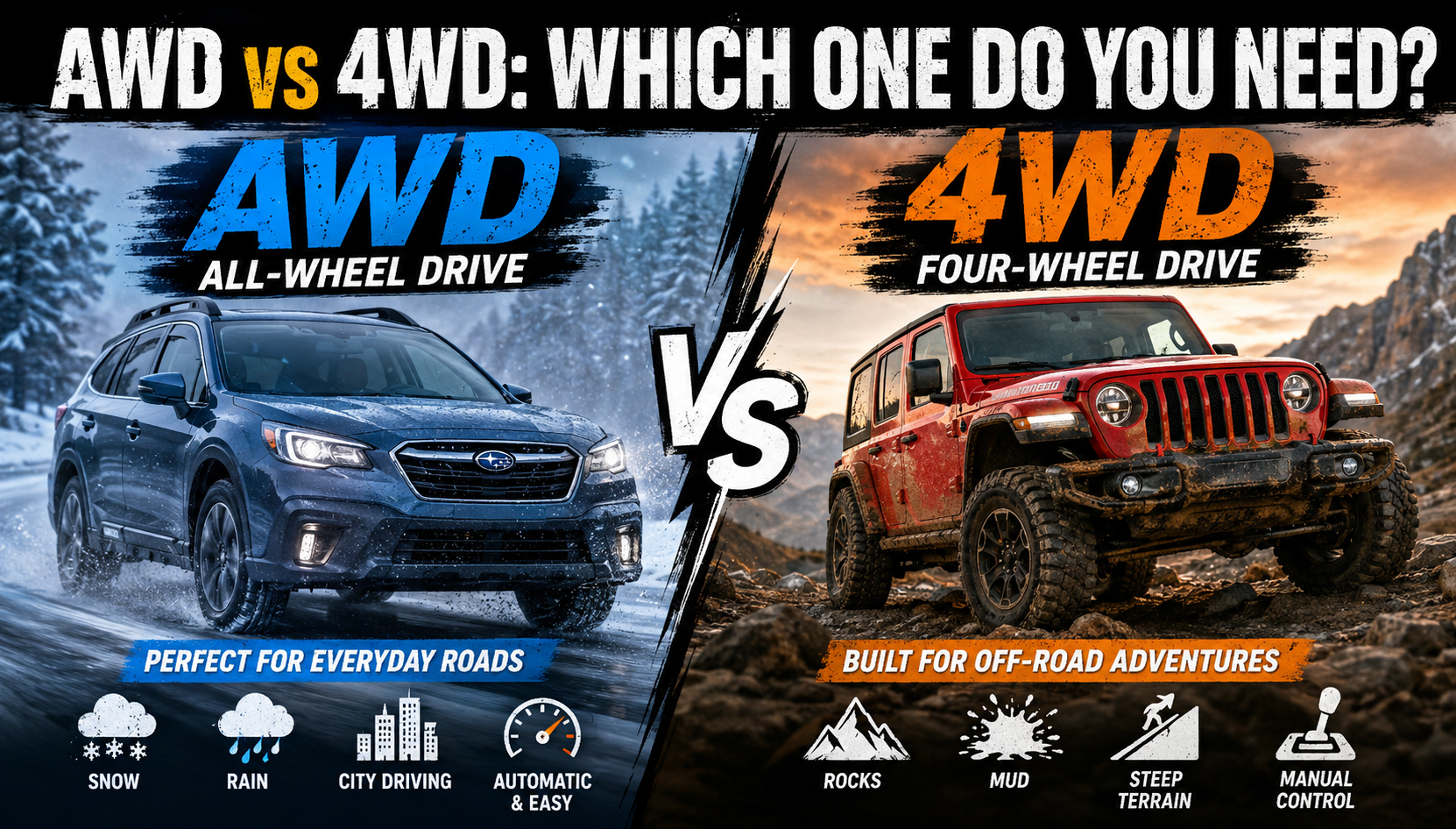
You’re standing at the dealership. The salesperson casually drops the words “AWD” and “4WD” like they’re secret VIP codes for surviving winter.
Suddenly, everyone around you acts like choosing the wrong one means your car will instantly slide into a frozen ditch while dramatic movie music plays in the background.
But here’s the truth: AWD and 4WD are not twins. They’re barely cousins who only meet at family barbecues.
One is designed for smooth, everyday confidence in bad weather. The other? It’s basically the wilderness survival expert who owns hiking boots, carries recovery boards, and somehow always says things like, “Bro, this trail gets CRAZY after rain.”
So which one do you actually need?
Let’s spill the automotive tea.
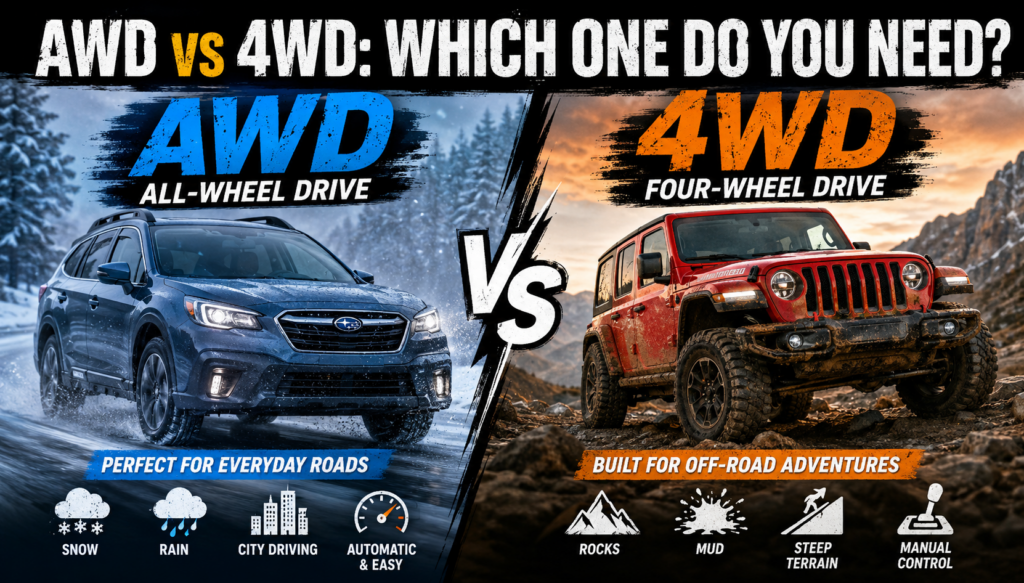
AWD: The Quiet Overachiever Everyone Secretly Loves
All-wheel drive (AWD) is the calm, reliable friend who doesn’t need attention but somehow saves the day every time the weather becomes chaotic.
Rainstorm? AWD handles it.
Unexpected snow? AWD says, “Relax, I got this.”
Sketchy wet highway at midnight? AWD quietly keeps things under control while you pretend you totally meant to hydroplane slightly.
The best part about AWD is that it works automatically. You don’t press buttons. You don’t twist knobs. You don’t need to feel like you’re launching a spaceship.
Modern AWD systems constantly monitor traction and secretly send power to the wheels that need it most. It’s basically automotive gossip management happening underneath your car in real time.
Most crossovers and SUVs today use AWD because it’s perfect for normal people who just want extra confidence without turning every grocery run into an expedition documentary.
Think vehicles like the Honda CR-V, Subaru Outback, or anything with fancy branding like “Quattro” or “4Matic.”
Luxury brands especially LOVE bragging about AWD like it’s a designer handbag.
And honestly? For daily driving, AWD is usually the smarter choice.
4WD: The Off-Road Celebrity With Main Character Energy
Now let’s talk about four-wheel drive (4WD).
This is not the quiet overachiever.
This is the loud, adventurous friend who buys camping gear after watching one survival YouTube video and suddenly thinks they can climb mountains.
4WD is built for serious stuff:
- Mud
- Rocks
- Deep snow
- Trails
- Places where cell service disappears and your mother starts worrying
Unlike AWD, 4WD usually requires driver input. That means YOU have to decide when things are getting messy enough to activate it.
Most 4WD vehicles give you settings like:
- 2H
- 4H
- 4L
And yes, it absolutely sounds like cheat codes from a video game.
Vehicles like the Jeep Wrangler, Ford F-150, and Toyota Tacoma use proper 4WD systems because they’re designed to survive rough terrain, steep climbs, and drivers who enjoy saying things like, “Let’s see what happens if we cross this river.”
Spoiler alert:
Sometimes the answer is expensive repairs.
The Biggest Difference? AWD Is Automatic. 4WD Is a Whole Lifestyle.
This is where people get confused.
AWD is designed mainly for roads.
4WD is designed mainly for OFF roads.
AWD works quietly in the background like an excellent personal assistant.
4WD demands participation. It wants buttons pressed. It wants dirt. It wants adventure photos for Instagram.
And here’s the important part many people ignore:
Most traditional 4WD systems should NOT be used on dry pavement.
That’s right.
Leave 4WD engaged on normal roads too long and your drivetrain may start protesting like it’s being forced into unpaid overtime.
Meanwhile AWD systems are perfectly happy staying active all the time.
This is why AWD dominates suburbs while 4WD dominates mountain trails and “overlanding” TikTok accounts.
Which One Is Better in Snow? Here Comes the Internet Argument
The moment snow enters the conversation, everybody suddenly becomes an automotive philosopher.
Here’s the reality:
AWD is fantastic for snow-covered roads and slippery commutes. It helps the car accelerate smoothly and maintain stability when conditions get sketchy.
But—and this is the part people hate hearing—AWD is NOT magic.
If your tires are terrible, AWD can only do so much.
A front-wheel-drive car with proper winter tires can absolutely embarrass an AWD vehicle running cheap all-season tires.
Yes, really.
This truth alone has started approximately 47 million arguments online.
4WD can also dominate in deep snow, especially in rural areas or unplowed roads, but for most commuters, AWD is the more practical option by a mile.
Unless your daily routine includes crossing frozen forests at sunrise while carrying camping fuel, you probably don’t need hardcore 4WD capability.
Fuel Economy: Your Wallet Has Opinions Too
Here’s where AWD and 4WD start becoming financially dramatic.
AWD systems are generally lighter and more fuel-efficient.
4WD systems? Not so much.
Those rugged components built for crawling over boulders don’t exactly scream “economical.”
So if you buy a massive 4WD truck just to drive to work and occasionally park near a hiking trail for selfies… your gas station probably loves you.
Deeply.
So… Which One Should You Actually Buy?
Let’s simplify this relationship drama.
Choose AWD if:
- You drive in rain or snow regularly
- You want easy, automatic traction
- You mostly stay on pavement
- You value comfort and convenience
- You don’t want to think about drivetrain settings
Choose 4WD if:
- You go serious off-roading
- You tow in rough terrain
- You drive through mud, rocks, or deep snow often
- You enjoy outdoor adventures
- You secretly want your vehicle to look like it belongs in an action movie
For most people, AWD is the realistic winner.
But for off-road enthusiasts? 4WD remains the undisputed king of chaos.
Final Verdict: Don’t Let Marketing Fool You
Automakers love making AWD and 4WD sound equally unstoppable, like both can survive the apocalypse without breaking a sweat.
Reality is less dramatic.
AWD is your dependable daily bodyguard.
4WD is your adrenaline-addicted wilderness cousin.
Both are useful. Both improve traction. But they’re built for completely different lifestyles.
And remember: no drivetrain can save reckless driving decisions.
Even the fanciest AWD system in the world cannot protect someone who thinks speeding through a snowstorm while texting is a personality trait.
Is AWD the same as 4WD?
No. AWD works automatically for everyday traction, while 4WD is mainly designed for serious off-road driving and usually requires driver input.
Is AWD better for snow?
For most drivers, yes. AWD helps with traction in snow, especially when paired with proper winter tires.
Can you drive with 4WD on all the time?
Usually not. Most traditional 4WD systems should only be used on slippery or loose surfaces, not dry pavement.
Which is better for daily driving: AWD or 4WD?
AWD is better for daily driving because it’s smoother, more fuel-efficient, and works automatically.
Does AWD improve braking?
No. Tires and road conditions matter far more for braking than AWD or 4WD systems.
Is AWD worth the extra money?
If you regularly drive in rain, snow, or slippery conditions, AWD is often worth the added confidence and traction.
Why do off-road enthusiasts prefer 4WD?
Because 4WD is built for mud, rocks, steep trails, and difficult terrain where AWD systems may struggle.
Can AWD go off-road?
Yes, but only lightly. AWD is fine for dirt roads and mild trails, while serious off-roading usually requires 4WD.
Which is more fuel-efficient: AWD or 4WD?
AWD is generally more fuel-efficient because it’s lighter and designed mainly for regular road use.