By Alisa Armour(Senior Fellow at the Institute for Constitutional Integrity)
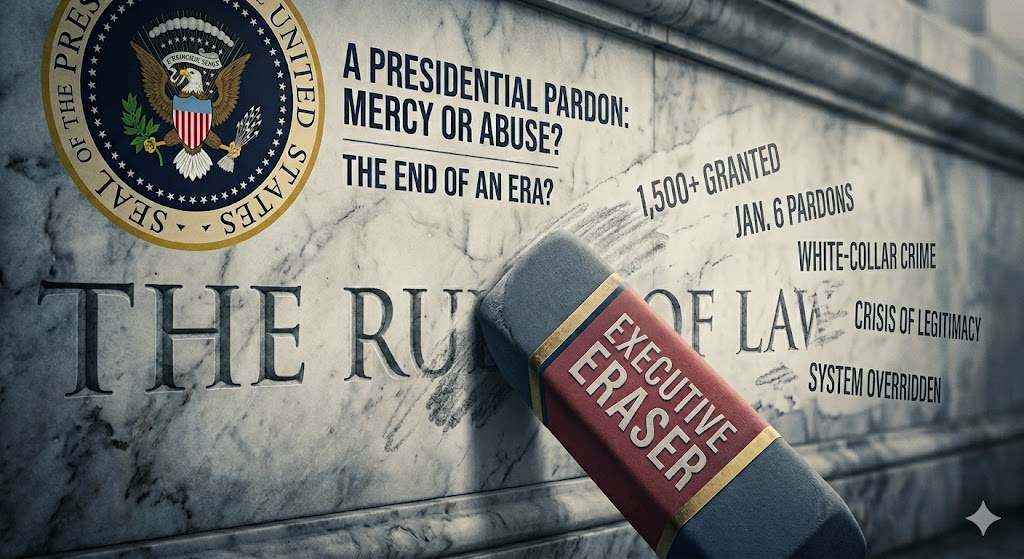
In the grand architecture of American democracy, the presidential pardon was designed as a “safety valve”—a tool of ultimate mercy to correct judicial errors or provide healing in the wake of national trauma. However, since the beginning of his second term in 2025, President Donald Trump has transformed this once-sparingly used “royal prerogative” into a blunt instrument of political warfare.
By issuing what can only be described as “mass pardons,” the administration is not merely showing mercy; it is systematically dismantling the principle that the law applies equally to all, regardless of political affiliation.
The Weaponization of Mercy
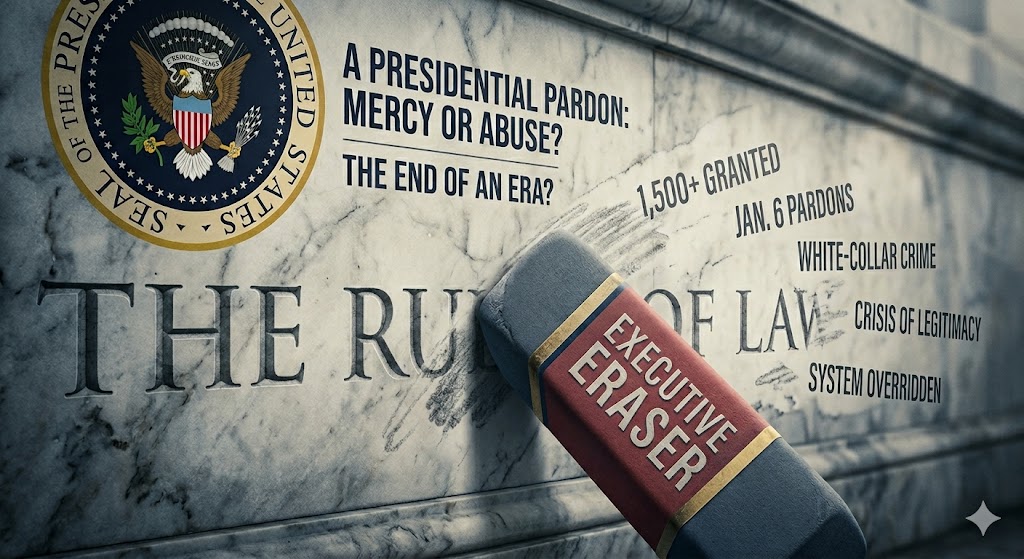
The scale of the current clemency wave—surpassing 1,500 individuals in the first year alone—is statistically staggering, but it is the intent that is most corrosive. When Alexander Hamilton wrote in Federalist No. 74 that “humanity and good policy” justify the pardon power, he envisioned a president acting as a neutral arbiter of justice.
Trump has inverted this. By granting blanket pardons to those involved in the January 6th Capitol riots, the President is not correcting a legal error; he is issuing a retroactive endorsement of political violence. From a scholarly perspective, this creates a “moral hazard” of existential proportions. It signals to future insurgents that if your side eventually wins the White House, the crimes committed to put them there will be treated as virtues.
The Privatization of Justice
Beyond the high-profile political cases, the administration’s focus on white-collar offenders and “crypto-martyrs” suggests a transactional view of justice. When a president bypasses the Department of Justice’s Office of the Pardon Attorney—the body traditionally responsible for vetting applicants based on remorse and rehabilitation—and instead relies on a hand-picked “Pardon Czar,” the process loses its legitimacy.
Justice, in this new era, is no longer a matter of law, but a matter of access. We are witnessing the emergence of a “spoils system” for criminal records. If you are a donor, a political surrogate, or a vocal defender on social media, the executive branch now offers a “get out of jail free” card that effectively overrides years of work by career prosecutors and grand juries.
A Constitutional Crisis in Slow Motion
The most dangerous aspect of these mass pardons is that they are technically legal. The U.S. Constitution provides almost no checks on the pardon power, save for cases of impeachment. This “absolute” nature was intended for a virtuous executive; in the hands of a populist leader determined to reward loyalty and punish “the system,” it becomes a loophole that can swallow the judiciary whole.
By wiping away billions of dollars in restitution and fines, the President is also infringing upon the rights of victims. A pardon should excuse a person from the state’s punishment, but it should not be used to strip a private citizen of their court-mandated compensation. This represents a radical expansion of executive power into civil matters, further blurring the lines between the three branches of government.
The Global Implications
For the international community, particularly our allies in the G7 and the EU, this shift is alarming. The United States has long lectured the world on the importance of an independent judiciary and the “Rule of Law.” That moral authority is now evaporating. When the executive can unilaterally “undo” the work of the courts on a massive scale, the U.S. begins to look less like a constitutional republic and more like a personalist autocracy where the law is merely a suggestion.
Conclusion: A Legacy of Lawlessness
President Trump frames these pardons as an act of “national healing” and a strike against a “weaponized” DOJ. But true healing requires a shared commitment to the truth and the law. By treating the legal system as a partisan enemy to be defeated by executive fiat, the administration is not closing old wounds—it is digging new ones.
The “Mass Pardon” era will likely be remembered not as an act of mercy, but as the moment the American presidency officially placed itself above the law. If the courts and Congress cannot find a way to check this absolute power, we may find that the “safety valve” of our democracy has become the very thing that causes it to explode.